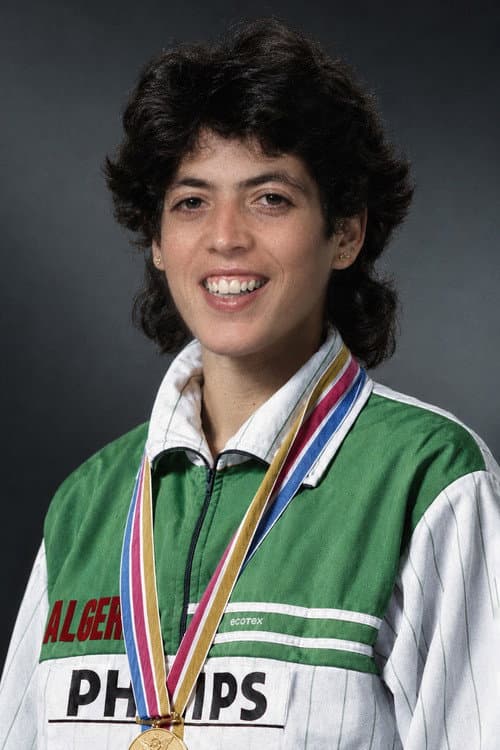
Hassiba Boulmerka (Arabic: حسيبة بولمرقة), born on July 10, 1968, in Constantine, is an Algerian athlete specializing in the 800-meter and 1,500-meter middle-distance events; her career spanned from 1986 to 1997.
Born in Constantine, in northeastern Algeria, Boulmerka began running seriously at the age of ten, specializing in the 800m and 1,500m events. She achieved success in national and regional competitions, although the level of competition was limited at the time. Her first major international event was the 1988 Summer Olympics in Seoul, where she was eliminated in the preliminary heats of both the 800m and 1,500m.
Boulmerka's performances gradually improved, and she experienced a major breakthrough in 1991. The first major race she won was the 800m at the Golden Gala meeting in Rome, Italy. A month later, she competed in the World Championships. In the home straight of the 1,500m final, she won the sprint, becoming the first African woman to win a world title in athletics.
This remarkable achievement did not elicit only positive reactions. She was frequently criticized by fundamentalist groups in Algeria during the bloody "Black Decade," as they objected to her exposing her body while running. Like many public figures, Boulmerka received death threats and was forced to relocate to Europe to train. Despite this, she was among the favorites for the 1,500m gold medal at the 1992 Barcelona Olympics. In the final, she defeated Lyudmila Rogachova and Qu Yunxia (the world record holder until 2015) to claim the gold. It was Algeria's first-ever Olympic gold medal. She won a bronze medal at the 1993 World Championships in Stuttgart. In 1995, she entered the World Championships in Gothenburg without having won a single race that season, yet she still managed to secure a second world title. It was her only victory of the season and her final major success. She competed in the Centennial Olympic Games in Atlanta but sprained her ankle during the semi-finals. After the 1997 season, during which she did not defend her world title, she retired from competitive sports. Hassiba Boulmerka was subsequently elected to the International Olympic Committee's Athletes' Commission.
She held the African record for the 1,500 meters with a time of 3:55.30, set on August 8, 1992, in Barcelona. She also held the African record for the mile (4:20.79)—set in Oslo in 1991—for 17 years, until it was broken by Ethiopia's Gelete Burika, who clocked 4:18.23 in 2008. After her athletic career, Hassiba Boulmerka returned to Algeria and held positions within sports organizations, notably as vice-president of the Algerian Olympic Committee and head of the National Elite Sports Committee; today, she is a businesswoman.