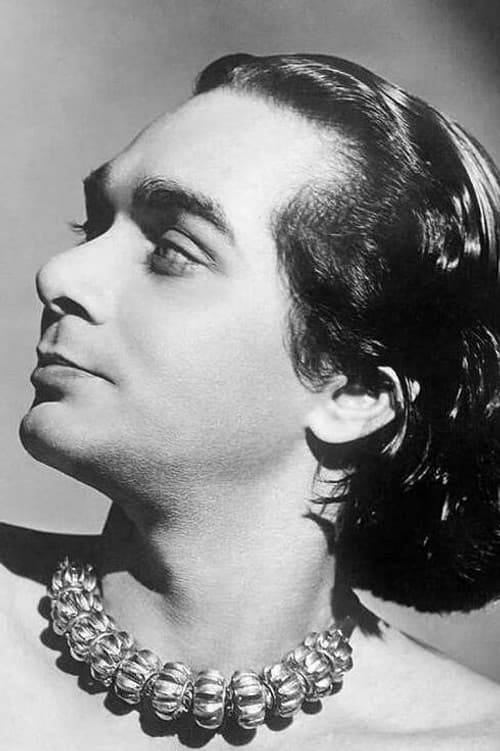
Uday Shankar (1900 – 1977) was an Indian dancer and choreographer, best known for creating a fusion style of dance, adapting European theatrical techniques to Indian classical dance, imbued with elements of Indian classical, folk, and tribal dance, which he later popularised in India, Europe, and the United States in the 1920s and 1930s. He was a pioneer of modern dance in India.
In 1962, he was awarded by Sangeet Natak Akademi, India's The National Academy for Music, Dance and Drama, with its highest award, the Sangeet Natak Akademi Fellowship for lifetime achievement, and in 1971, the Govt. of India, awarded him its second highest civilian award the Padma Vibhushan.
Uday Shankar Chowdhury was born in Udaipur, Rajasthan, the eldest son of an Brahmin family with origins in Narail (present-day Bangladesh). Uday Shankar did not have any formal training in any of the Indian classical dance forms. Nevertheless, his presentations were creative. From a young age, he had been exposed to both Indian classical dance and folk dance, as well as to ballet during his stay in Europe. He decided to bring elements of both styles together to create a new dance, which he called Hi-dance. He went on to translate classical Indian dance forms and their iconography to dance movements, after studying the Rajput painting and Mughal painting styles at the British Museum. Further, during his stay in Britain, he came across several performing artists, subsequently when he left for Rome on the 'Prix de Rome' scholarship of the French Government, for advanced studies in art.