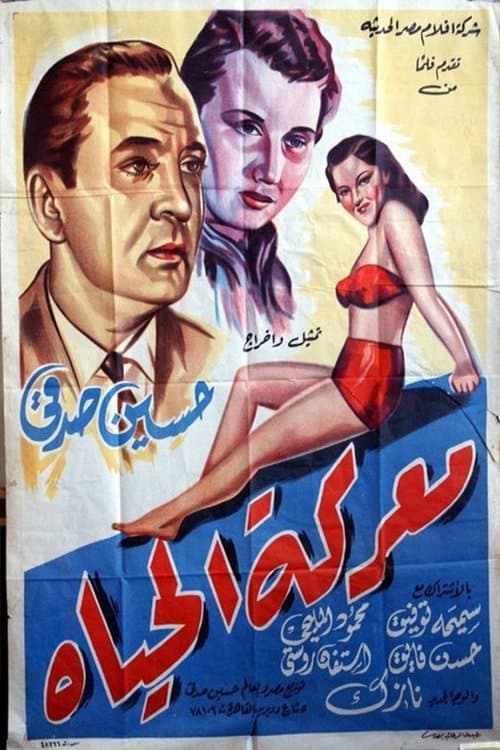
A Lebanese singer, it is said that her family emigrated from Libya. Her real name is Hiba Al-Madaka Al-Husseini. She was discovered by Halim Al-Roumi in 1946, who invited her to work at the Near East Radio, as a trainee chorus singer. He then presented her on the programs of her first radio station in her life. The critic Kamal Al-Najmi gave her the nickname: Asmahan's twin, a nickname that greatly prevented her from launching her artistic career in a way that suited her beautiful voice. She traveled to Cairo in 1953 to participate in the lead role in the film (Bint Al-Jiran) produced by director Mahmoud Zulfikar, but due to financial circumstances, the film faltered. Luckily for her, she was met by the musician Ahmed Sedky, who was impressed by her voice and composed the song "Sahran" for her. Ahmed Sedky, Raouf Zohni, Riad Al-Sunbati, Ali Ismail, and Mohamed El-Qasabgi composed music for her.
Mohamed Fawzy was impressed by her voice and featured her in his famous film (Kol Daqat Fi Qalbi) and made Nazik's song the title of the film.
Because she was extremely shy, she stayed away from cinema, focusing on radio and concerts. She then left for Lebanon in the late 1950s. She returned to Cairo in 1960 and recorded "Al-Dawwama" by Abdel Azim Mohamed, "Ana wa Al-Nojoom" by Ahmed Sedky, and "Taht Al-Tut" by Mohamed Mohsen, which became very popular and achieved widespread acclaim. She then returned and settled in Beirut in 1963. In Lebanon, Nazik suffered greatly in Beirut, as Lebanese radio and television stations and studios were closed in her face. While she was fighting in Beirut to be listened to and watched by people, her famous and very successful songs were being broadcast on Cairo and other radio stations, which led to a nervous breakdown that led to her being hospitalized. After leaving the hospital, she dedicated her voice to performing religious supplications and hymns, and retired from singing in theaters and public forums, devoting herself only to supplications and praises of the Prophet. She distanced herself from the outside world and became known as Nazik, the prisoner of art. Her religiosity intensified, and she began wearing the veil. She passed away on August 6, 1999, and her songs are still being broadcast on the radio, and her albums are being well distributed.