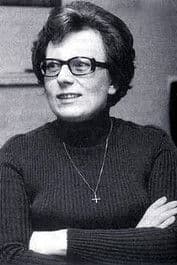
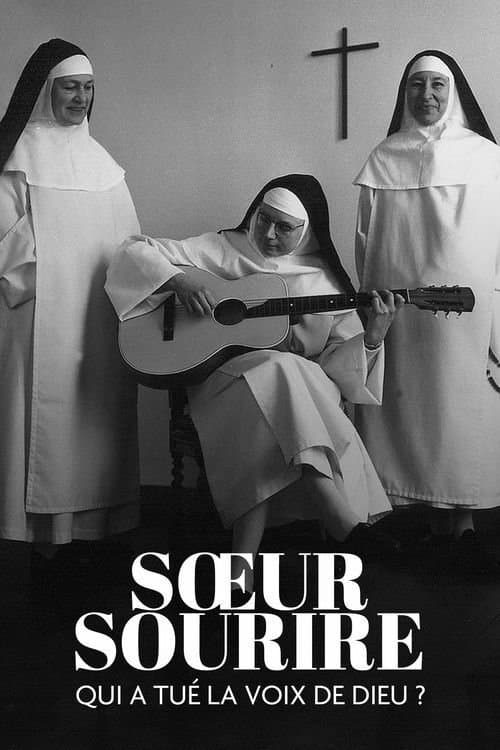
Jeanne-Paule Marie "Jeannine" Deckers (17 October 1933 – 29 March 1985), better known as Sœur Sourire (French for 'Smiling Sister') and often called The Singing Nun in English-speaking countries, was a Belgian singer-songwriter and a member of the Dominican Order in Belgium as Sister Luc Gabriel. She acquired widespread fame in 1963 with the release of the Belgian French song "Dominique", which topped the US Billboard Hot 100 and other charts. Owing to confusion over the terms of the recording contract, she was reduced to poverty, and also experienced a crisis of faith, quitting the order, though still remaining a Catholic. She died by suicide with her lifelong partner, Annie Pécher.
She was born Jeanne-Paule Marie Deckers, in Laeken, Brussels, Belgium, in 1933, the daughter of a pâtisserie owner, and was educated in a Catholic school in Brussels. Her mother thought of her as a "tomboy" and was pleased when she decided to join the all-girl Guides Catholiques de Belgique (GCB). When she was fifteen she had a premonition that she would become a nun. She became an avid Girl Guide who bought her first guitar to play at Guide evening events. While studying for three years after high school, to obtain a diploma for teaching sculpture, she considered dedicating her life to religion in a Catholic convent. From the age of 21, between 1954 and 1959, she taught sculpture to youngsters. At scout camp in the summer of 1959 she met sixteen-year-old Annie Pécher, with whom she would develop a close relationship. She became convinced, however, that her new teaching profession did not suit her and she resigned. In September 1959 she entered the Missionary Dominican Sisters of Our Lady of Fichermont, headquartered in the city of Waterloo, where she took the religious name "Sister Luc Gabriel".
While in the convent, Sister Luc Gabriel wrote, sang, and casually performed her own songs, which were so well received by her fellow nuns and visitors that her religious superiors encouraged her to record an album, which visitors and retreatants at the convent would be able to purchase.
In 1962, the album was recorded in Brussels at Philips; in 1963 the single "Dominique" became an international hit, and her album sold nearly two million copies. Sister Luc Gabriel became an international celebrity and took the stage name of Sœur Sourire ("Sister Smile"). She gave several live concerts and appeared on The Ed Sullivan Show on television on 5 January 1964. "Dominique" was the first song by a Belgian artist to be a number one hit single in the United States. The song's chorus refrain "Dominique, nique, nique" was the source of some unintended amusement amongst French listeners as the word "niquer" is short for "fornicate", with "nique" the equivalent of "fuck"; Deckers was unaware of the connotation, as were the other Belgian Catholics of that era.
Sister Luc Gabriel found it difficult, however, having to live up to her publicity as "a true girl scout," always happy and in a good mood. "I was never allowed to be depressed," she remembered in 1979. "The mother superior used to censor my songs and take out any verses I wrote when I was feeling sad." ...
Source: Article "The Singing Nun" from Wikipedia in English, licensed under CC-BY-SA 3.0.