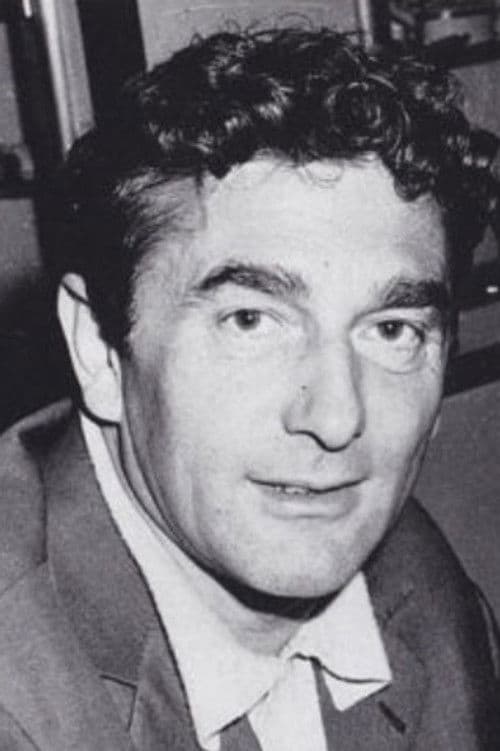
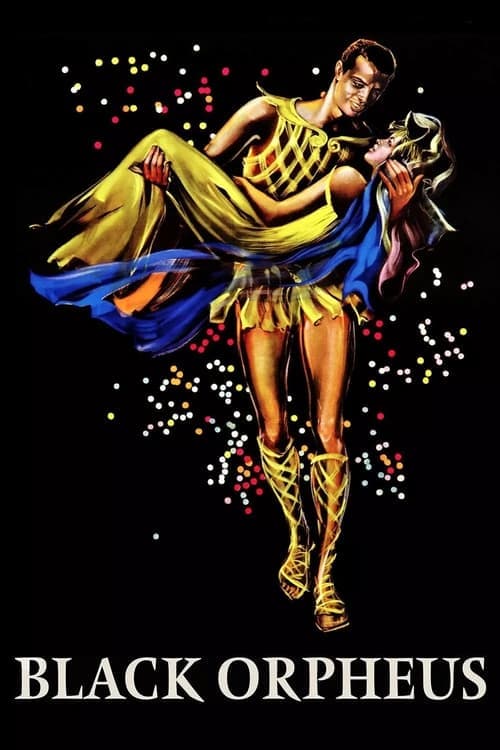
Marcel Camus (21 April 1912 – 13 January 1982) was a French film director. He is best known for Orfeu Negro (Black Orpheus), which won the Palme d'Or at the 1959 Cannes Film Festival and the 1960 Oscar for Best Foreign Language Film.
Camus was born in Chappes, in the Ardennes département of France. He studied art and intended to become an art teacher. However, World War II interrupted his plans. He spent part of the war in a German prisoner-of-war camp.
On his return from captivity, his uncle, famous novelist, Roland Dorgelès introduced him to several film-makers. Camus assisted filmmakers in France, including Jacques Feyder, Luis Buñuel, and Jacques Becker.
In a famous photo of the French New Wave filmmakers, taken on the steps of the Palais des Festivals in Cannes in 1959, Marcel Camus appears alongside François Truffaut, François Reichenbach, Claude Chabrol, Jacques Doniol-Valcroze, Jean-Luc Godard, Roger Vadim, Jean-Daniel Pollet, Jacques Rozier, Jacques Baratier, Jean Valère, Édouard Molinaro and Robert Hossein.
In 1958, at the suggestion of producer Sacha Gordine, he travelled to Brazil to adapt for the screen, with the help of Jacques Viot, a play by famous poet and diplomat Vinícius de Moraes, Orfeu da Conceição, which became Orfeu Negro. It was a transposition of the love story of Orpheus and Eurydice to the favelas of Rio de Janeiro during Carnival.
The film won over both the general public and a large proportion of the critics. The film was a worldwide success, winning several awards including the Palme d'Or at the 1959 Cannes Film Festival and the Academy Award for Best International Feature Film in 1960.
It introduced Europeans and Americans to Rio, Carnival and bossa nova, with unknown black actors and a tender view of Brazil. American-French actress Marpessa Dawn, who played Eurydice in the film, became the director's wife.
In 1960, Camus made a second Brazilian-themed film, Os Bandeirantes. This adventure film follows a French diamond miner in Brazil who, after being betrayed and left for dead by a friend, embarks on a quest for vengeance but finds himself falling in love with a Brazilian woman along the way.
Twenty years after Orfeu Negro, Camus returned to Brazilian themes for what would prove to be his last film, Bahia (also known as Otalia da Bahia and Os pastores da noite), based on a novel by Brazilian novelist Jorge Amado. These films, however, failed to recapture the success of Orfeu Negro.
In 1976, he returned to the country that fascinated him and his wife, Brazil, to direct Otalia de Bahia, adapted from Jorge Amado's novel Os pastores da noite (Shepherds of the Night).
In 1970, Camus had a last great success with a World War II comedy, Atlantic Wall, starring the well-known French comedian Bourvil. It was the second most popular film in France in 1970, attracting 4 770 962 viewers. Camus ended his career working primarily in television.
Camus married one of the stars of Orfeu Negro, Marpessa Dawn, but they divorced shortly thereafter. He then married another actress from Orfeu Negro, Lourdes de Oliveira. Camus and de Oliveira have two children, including the writer Jean-Christophe Camus.
Camus died in Paris and is buried there in Père Lachaise Cemetery.
Source: Article "Marcel Camus" from Wikipedia in English, licensed under CC-BY-SA.