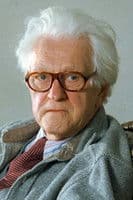
Nicolas Nabokov (Николай Дмитриевич Набоков; 17 April [O.S. 4 April] 1903 – 6 April 1978) was a Russian-born composer, writer, and cultural figure. He became a U.S. citizen in 1939.
Nicolas Nabokov, a first cousin of Vladimir Nabokov, and of the baron Eduard von Falz-Fein, was born to a family of landed Russian gentry in the town of Lubcza near Minsk, and was educated by private tutors. In 1918, after his family fled the Bolshevik Revolution to the Crimea, he began his musical education with Vladimir Rebikov. After living briefly in Germany he settled in Paris in 1923, where he studied at the Sorbonne.
Nabokov was married five times. His first wife was the Russian princess Nathalie Shakhovskaya (1903–1988). His last (1970–1978) was the French photographer Dominique Nabokov.
He had three sons: renowned French publisher Ivan Nabokov, Alexander Nabokov, and anthropologist Peter Nabokov. His close friends included the philosopher and fellow émigré Isaiah Berlin and composer Igor Stravinsky.
After the years in Paris 1923–1932, in 1933 he moved to the U.S. as a lecturer in music for the Barnes Foundation. He taught music at Wells College in New York from 1936 to 1941, then moved to St. John's College in Maryland. In 1945, he worked for the U. S. Strategic Bombing Survey in Germany, on the suggestion of W. H. Auden, and stayed to work as a civilian cultural advisor in occupied Germany. Back in the US, he taught at the Peabody Conservatory from the fall of 1944 until the spring of 1945, then, in 1950–1951, served as music director at the American Academy in Rome.
In 1949, Nabokov attended a New York press conference of the visiting Soviet composer Dmitri Shostakovich and publicly humiliated him by showing he was not a free agent and had to represent the positions of Stalin's government, by asking him if he approved the Sovietic censorship over Stravinsky's music, to which Shostakovich had no option than replying that he did. In 1951, Nabokov became Secretary General of the newly formed Congress for Cultural Freedom (CCF), backed by the CIA, and remained in the job for more than fifteen years, organizing music and cultural festivals. With the effective dissolution of the CCF in 1967, Nabokov found a series of teaching jobs at American universities, and in 1970, became resident composer at the Aspen Institute for Humanistic Studies, where he remained until 1973. Although he was well-connected socially, very little of his music has been recorded as of November 2010.
Source: Article "Nicolas Nabokov" from Wikipedia in English, licensed under CC-BY-SA 3.0.