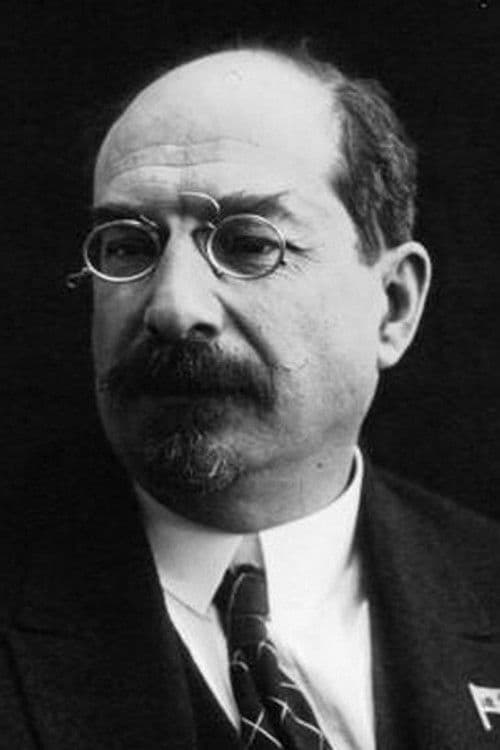
Russian revolutionary, Soviet statesman, writer, translator, publicist, critic, art critic. From October 1917 to September 1929 - the first People's Commissar of Education of the RSFSR, an active participant in the revolution of 1905 and the October Revolution. Academician of the USSR Academy of Sciences (February 1, 1930). In 1896-1898, the young Lunacharsky traveled to France and Italy, and in 1898 he came to Moscow, where he began to engage in revolutionary work. In 1904, after the end of his exile, Lunacharsky moved to Kiev, and then to Geneva, where he became a member of the editorial boards of the Bolshevik newspapers Proletary and Vperyod. Soon Lunacharsky became one of the leaders of the Bolsheviks. He became close to A. A. Bogdanov and V. I. Lenin; under the leadership of the latter, he participated in the struggle against the Mensheviks - Martov, Dan and others. He took part in the work of the III Congress of the RSDLP, where he made a report on the armed uprising and the IV Congress of the RSDLP (1906). In October 1905 he went to Russia for agitation. Started working for the newspaper "New Life"; was soon arrested and put on trial for revolutionary agitation, but fled abroad. In 1906-1908 he was the head of the art department of the magazine "Education". By the end of the 1900s, the philosophical differences between Lunacharsky and Lenin intensified, soon escalating into a political struggle. In 1909, Lunacharsky took an active part in organizing the extreme left group "Vperyod", which included "ultimatumists" and "otzovists", who believed that Social Democrats had no place in the Stolypin Duma, and who demanded the withdrawal of the Social Democratic faction. Since the Bolshevik faction excluded this group from its ranks, later, until 1917, Lunacharsky stayed outside the factions. “Lunacharsky will return to the party,” Lenin said to Gorky, “he is less individualistic than those two (Bogdanov and Bazarov). An extremely richly gifted nature. " Lunacharsky himself noted about his relationship with Lenin (refers to 1910): "We personally did not break off relations and did not aggravate them." Together with other "vperyodovtsy" he participated in the creation of party schools for Russian workers in Capri and Bologna; representatives of all factions of the RSDLP were invited to give lectures at this school. During this period he was influenced by the empirio-critical philosophers; was subjected to harsh criticism by Lenin (in the work "Materialism and Empirio-Criticism", 1908). In 1907, Lunacharsky took part in the Stuttgart Congress of the International, then in Copenhagen. He worked as a columnist for Western European literature in many Russian newspapers and magazines, spoke out against chauvinism in art. From the very beginning of the First World War, Lunacharsky took an internationalist position, which was strengthened under the influence of Lenin; was one of the founders of the pacifist newspaper Nashe Slovo, about which I. Deutscher wrote: "Nashe Slovo gathered a wonderful circle of authors, almost each of whom wrote his name in the annals of the revolution." At the end of 1915, he moved with his family from Paris to Switzerland.