From Wikipedia, the free encyclopedia.
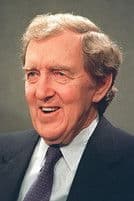
Edmund Sixtus Muskie (March 28, 1914 – March 26, 1996) was an American statesman and political leader who served as the 58th United States Secretary of State under President Jimmy Carter from 1980 to 1981, a United States Senator from Maine from 1959 to 1980, the 64th Governor of Maine from 1955 to 1959, and a member of the Maine House of Representatives from 1946 to 1951. He was the Democratic Party's nominee for vice president in the 1968 presidential election.
Born in Rumford, Maine, he worked as a lawyer for two years before serving in the United States Naval Reserve from 1942 to 1945 during World War II. Upon his return, Muskie served in the Maine State Legislature from 1946 to 1951, and unsuccessfully ran for mayor of Waterville. Muskie was elected the 64th governor of Maine in 1954 under a reform platform as the first Democratic governor since Louis J. Brann left office in 1937, and only the fifth since 1857. Muskie pressed for economic expansionism and instated environmental provisions. Muskie's actions severed a nearly 100-year Republican stronghold and led to the political insurgency of the Maine Democrats.
Muskie's legislative work during his career as a senator coincided with an expansion of modern liberalism in the United States. He promoted the 1960s environmental movement which led to the passage of the Clean Air Act of 1970 and the Clean Water Act of 1972. Muskie supported the Civil Rights Act of 1964, the creation of Martin Luther King Jr. Day, and opposed Richard Nixon's "Imperial presidency" by advancing New Federalism. Muskie ran with Vice President Hubert Humphrey against Nixon in the 1968 presidential election, losing the popular vote by 0.7 percentage point—one of the narrowest margins in U.S. history. He would go on to run in the 1972 presidential election, where he secured 1.84 million votes in the primaries, coming in fourth out of 15 contesters. The release of the forged "Canuck letter" derailed his campaign and sullied his public image with Americans of French-Canadian descent.
After the election, Muskie returned to the Senate, where he gave the 1976 State of the Union Response. Muskie served as first chairman of the new Senate Budget Committee from 1975 to 1980, where he established the United States budget process. Upon his resignation from the Senate, he became the 58th U.S. Secretary of State under President Carter. Muskie's tenure as Secretary of State was one of the shortest in modern history. His department negotiated the release of 52 Americans, thus concluding the Iran hostage crisis. He was awarded the Presidential Medal of Freedom by Carter in 1981 and has been honored with a public holiday in Maine since 1987.