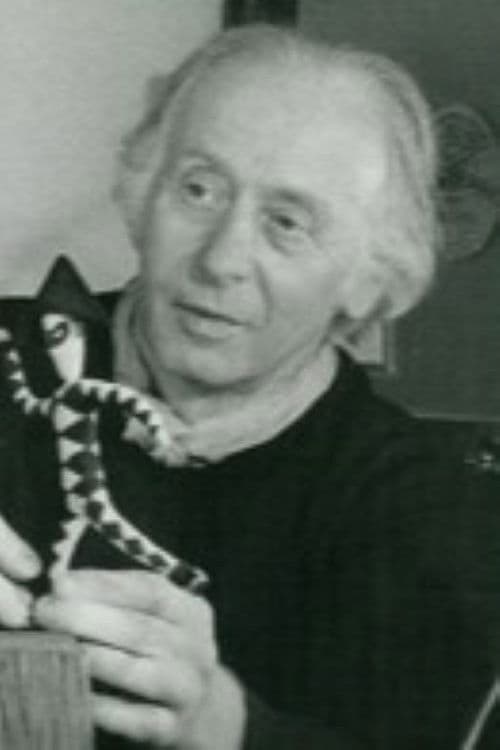
Julien Pappé was born in 1920 in Rzeszow, Poland. From a very young age, he was interested in meticulous craftsmanship and joined a model-making club. He later put his talent to use in the manufacture of wooden puppets. When war broke out, he was enlisted as a young officer and formed a puppet theatre troupe with his fellow officers. This gave him the opportunity to satirise the absurdity of war.
During the war, he found himself in Russia, where he remained for four years. During this journey, he arrived in Alma-Ata and came across the film sets of Sergei Eisenstein, who was preparing Ivan the Terrible. In 1941, Julien Pappé was hired by the set design team to create the film's scenery. This experience was decisive for his future career. He then spent two years at Moss-Films in Moscow.
When the war ended, he returned to Poland and set up a puppet theatre, Teatr i Lalka, in Lodz. He installed his troupe and wooden puppets in an old cinema. The theatre was a success and he was invited to present his shows in Paris as part of a festival organised by UNESCO.
He decided not to return to Poland and settled permanently in Paris in 1948. He quickly became interested in animation and set up his first studio in the cellars of La Villette. In 1953, the Magic Films studio was born. He built his first title bars. In 1961, he joined forces with the ORTF research department and co-produced several films in very different genres. This collaboration lasted until 1969. He benefited from resources that allowed him to experiment with different techniques of expression. Thanks to this freedom, he was able to develop a truca that enabled him to create unprecedented visual effects (around 1963). His invention was so innovative for the time that many filmmakers came to his studio to explore its possibilities, including the directors of the French New Wave, for whom he made trailers. Advertisers also became interested in the possibilities of truca and commissioned films from him. It was a precursor to today's virtual images.
In 1964, Julien Pappé set up his studio in Meudon. The land was undeveloped, and he built a huge 400 m² house there, with his film sets and living quarters. He remained there until 2000...