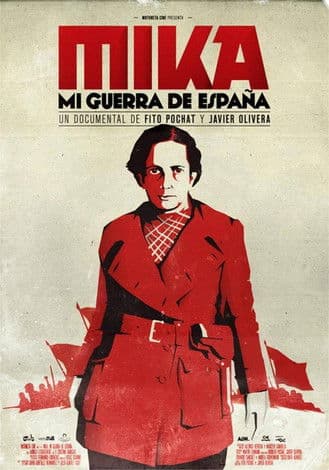
Mika Feldman de Etchebéhère (née Micaela Feldman; Moisés Ville, Santa Fe Province, March 14, 1902 — Paris, July 7, 1992) was an Argentine militant anarchist and Marxist. She served as captain of the POUM militia during the Spanish Civil War in 1936, and was also active in the anarcha-feminist organization, Mujeres Libres.
Mika was born in 1902, in Moisés Ville, a small colony founded in 1889 in the province of Santa Fe, in Argentina, by Russian and Eastern-European Jews fleeing persecutions and pogroms. Her father taught Yiddish in Moisés Ville, before moving to Rosario, where he opened a small restaurant. As a child, Mika allegedly heard many stories about Russian revolutionary fighters escaping tsarist prisons.
At age 15, she began being an active member of Rosario's local anarchist organization. Along with Eva Vives, Joan Pauna and other fellow activists, she created a group named after Louise Michel, the famous anarchist figure of the French commune.
In 1920, while studying odontology at the University of Buenos Aires, she met her partner-to-be, Hipólito Etchebéhère, then a member of an anarcho-communist group called "Insurrexit".
In 1924, inspired by the Russian revolution, the couple decided to join the Communist Party of Argentina, before quickly being expelled in 1925 for their anarchist tendencies, and their refusal to unilaterally condemn Leon Trotsky.
In 1926, she took part in the creation of a Workers' Communist Party, which started publishing a newspaper, La Chispa ("the Spark"). Members of this Trostkyist, anti-bolchevik group were thus called "Chispistas". The group eventually disbanded in 1929.
Mika then traveled to Patagonia in order to gather the stories of first-hand witnesses of the massacre perpetrated in the early 1920s by the Argentinian army during what has been called "Patagonia Rebelde".
In 1930, Mika and her partner sailed to Europe. First, in June, they spent time in the freshly founded Second Spanish Republic, before going to France. In October 1932, Mika was in Berlin to witness Adolf Hitler's rise to power, which she described as "a tragedy for the German proletariat".
In 1934, as she had returned to Paris, she and Hipólito took part in creating yet another newspaper, Que faire?, also known for its communist and anti-stalinist views.
On July 12, 1936, six days before the Spanish coup of July 1936, Mika was back in Madrid. She and her partner volunteered as fighters for the Workers' Party of Marxist Unification (POUM). Hipólito became the commander of his division. On August 16, 1936, he was shot and killed during the Battle of Sigüenza. ...
Source: Article "Mika Feldman de Etchebéhère" from Wikipedia in English, licensed under CC-BY-SA 3.0.