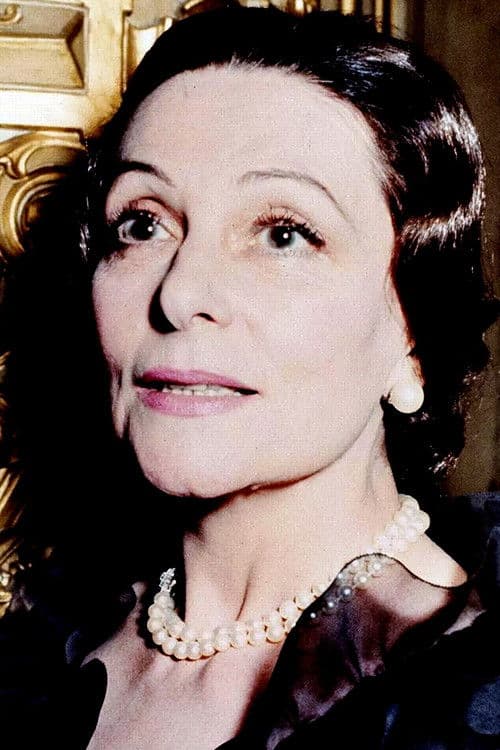
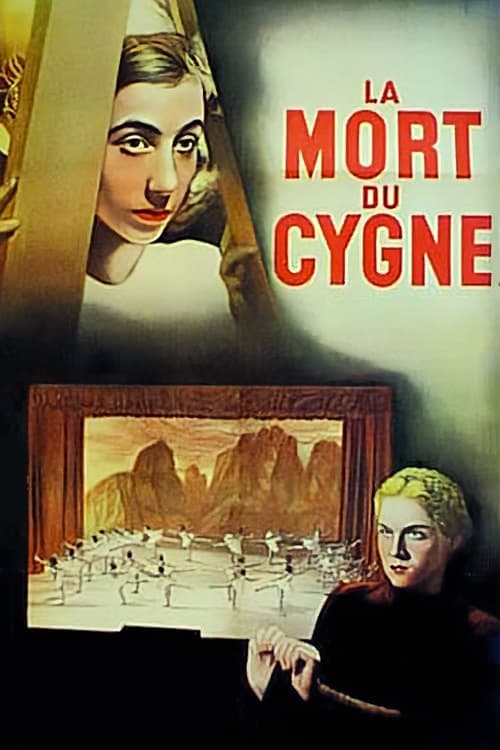
Yvette Chauviré (22 April 1917 – 19 October 2016) was a French prima ballerina and actress. She is often described as France's greatest ballerina, and was the coach of prima ballerinas Sylvie Guillem and Marie-Claude Pietragalla. She was awarded the Légion d'Honneur in 1964.
Yvonne Chauviré was born in Paris on 22 April 1917. Aged 10, in 1927, she entered the Paris Opera Ballet school, and at the age of 12 she was noticed for her performance in the children's ballet L'Eventail de Jeanne ("Jeanne's Fan"). When she was 13, she was invited to join the opera's ballet company.
Chauviré rose through the ranks of dancers at the Paris Opera Ballet, becoming principal dancer in 1937 and étoile, the highest rank, in 1941.
She was the star of a number of experimental works choreographed by the company's director Serge Lifar, including Alexandre le Grand, Istar, Suite en Blanc and Les Mirages. Lifar also encouraged her to study with two Russian choreographers Boris Kniaseff and Victor Gsovsky, who influenced her style towards lyricism and away from her hard-lined academic training.
Although never a pupil of Carlotta Zambelli's, Chauviré later admitted that she spent a great deal of time watching Zambelli teach and learnt to copy her techniques and movements and then to make them her own.
Lifar was forced to leave the company in 1945 after being accused of supporting Germany during World War II and the following year Chauviré also left, following Lifar to his newly formed company, the Nouveau Ballet de Monte-Carlo. In 1947 both Lifar and Chauviré returned to the Paris Opera Ballet; however, Chauviré left again in 1949 due to contractual disagreements with the company over her freedom to dance with other companies. She performed in a range of productions, including two made by her former teacher Gsovsky: Grand pas classique, for the Ballets des Champs-Elysées, and La Dame aux camélias, for the Berlin Ballet.
In 1953 the Paris Opera Ballet agreed to a more flexible contract and she returned to the company but continued to dance as a guest performer with companies in Europe, the United States, South Africa and Latin America. She often danced with Rudolf Nureyev, who described her as a "legend", and also danced with Māris Liepa and Erik Bruhn. During this time she widened her range of roles and began to perform in more classical productions such as Giselle, Sleeping Beauty and The Nutcracker. The role of Giselle became a particular passion for Chauviré, and she considered it her signature piece.
Chauviré retired from the Paris Opera Ballet in 1956, but continued to appear with the company until 1972. She was also co-director of the Paris Opera Ballet school from 1963 to 1968, and taught Sylvie Guillem and Marie-Claude Pietragalla. She choreographed some short ballets herself In 1970, she became Director of the International Academy of Dance, in Paris.
In a 1989 interview, she characterised contemporary style as becoming "more and more slipshod", and criticised the fashion for "extreme" ballet movements as risking injury to the dancer. She said she had tried during her career, "to simplify, within the greatest technical difficulty". ...
Source: Article "Yvette Chauviré" from Wikipedia in English, licensed under CC-BY-SA 3.0.