Browse 83 movies from Robert W. Paul
Four men of different ranks play a game of tetherball on a ship's deck.
Jan 1898
A Swiss tourist knocks the head off a negro waiter.
Dec 1902
A magician performs tricks. First with a top hat, then with his audience.
Sep 1899
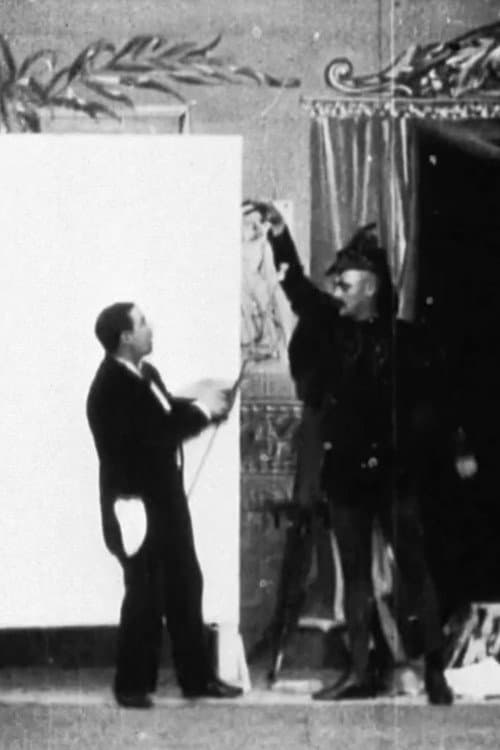
Mephistopholes causes an artist's model to disappear.
Aug 1901
Come Along, Do! is an 1898 British short silent comedy film, produced and directed by Robert W. Paul. The film was of 1 minute duration, but only forty-some seconds have survived. The whole of the second shot is only available as film stills. The film features an elderly man at an art gallery who takes a great interest in a nude statue to the irritation of his wife. The film has cinematographic significance as the first example of film continuity. It was, according to Michael Brooke of BFI Screenonline, "one of the first films to feature more than one shot." In the first shot, an elderly couple is outside an art exhibition having lunch and then follow other people inside through the door. The second shot shows what they do inside.
A miser dies of shock when the ghost of a poor woman appears.
A man and a woman talk beside a street near a corner where a cop stands. Just as a horse-drawn cart rounds the corner, the man backs off the sidewalk saying good-by to his companion. The horse and cart flatten him and continue on, out of the camera's stationary range. The cop runs after the cab, the woman dashes to the body. The cop brings back the driver; is the victim dead?
Nov 1903
Drama by Walter R. Booth. Survival status unknown.
Oct 1900
Husband comes home late and wakes the wife. Based on a popular stage play.
Aug 1896
An 1895 British short black and white silent comedy film featuring two drunken men and a boy squabbling in a small bar.
Mar 1895
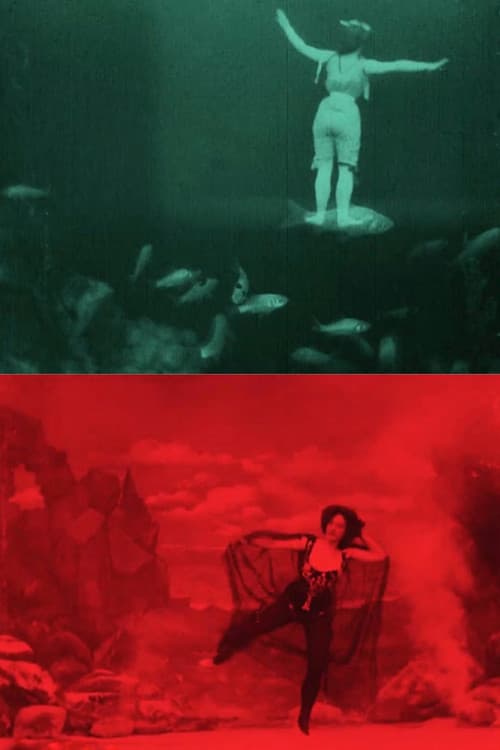
A ballerina dreams of dancing under the sea.
Sep 1905
Two sports are seen drinking beer and arguing as to the qualities of certain prize fighters. They make a bet, and to prove it, each pulls his favorite pugilist from his pocket, and they set them on the table. A hot battle ensues, in which one of the midgets is knocked out. The sport whose favorite won the fight takes the money with a look of satisfaction, and replaces his man in his pocket. The loser looks very much disgusted as he picks up his man and puts him back in his pocket. Very mystifying.
Mar 1903
A satire on the way that audiences unaccustomed to the cinema didn't know how to react to the moving images on a screen - in this film, an unsophisticated (and stereotypical) country yokel is alternately baffled and terrified, in the latter case by the apparent approach of a steam train.
Oct 1901
Britain's first drama (i.e. non documentary) film.
May 1896
The Waif and the Wizard features the same young man who appeared in Undressing Extraordinary (and who might be early filmmaker Walter Booth). It's another early example of a two-shot film along the lines of Paul's earlier film Come Along Do!. The young man plays a magician who, after completing his act, agrees to go home with the young boy from the audience who helped him perform his tricks. At the boy's home he finds a sick sister and a worried mother being threatened with eviction by her landlord.
Sep 1901
A 19th century wire-walker performs his stage act on a woman's clothesline. An early comedy by pioneer director Robert W. Paul.
Sep 1897
The scene is a railroad track on the side of a steep mountain, with a tunnel in the background, toward which a train is running at a high rate of speed. At this instant the audience is appalled at the sight of a second train rushing out of the tunnel. Both trains are on the same track and traveling toward each other at a high rate of speed. They collide. Cars and engines are smashed into fragments and thrown down the steep incline. (Edison Catalog)
Mar 1900
A husband rushes for a doctor and his wife has triplets.
Aug 1904
The surf pounds against a breakwater on which are visible several people standing. The wall looks to be about 20 feet above sea level and extend at least 100 feet into the water. A large wave rolls picturesquely along the wall toward the shore. Smaller waves follow. Then the scene changes to river water flowing. We see both shores: in the foreground a log and tree branch are visible; on the far shore, there appears to be a low wall with trees beyond it. The camera is stationary in both shots.
Jan 1896