Browse 28 movies from TsOKS
Set during the early part of his reign, Ivan faces betrayal from the aristocracy and even his closest friends as he seeks to unite the Russian people. Sergei Eisenstein's final film, this is the first part of a three-part biopic of Tsar Ivan IV of Russia, which was never completed due to the producer's dissatisfaction with Eisenstein's attempts to use forbidden experimental filming techniques and excessive cost overruns. The second part was completed but not released for a decade after Eisenstein's death and a change of heart in the USSR government toward his work; the third part was only in its earliest stage of filming when shooting was stopped altogether.
Nov 1944
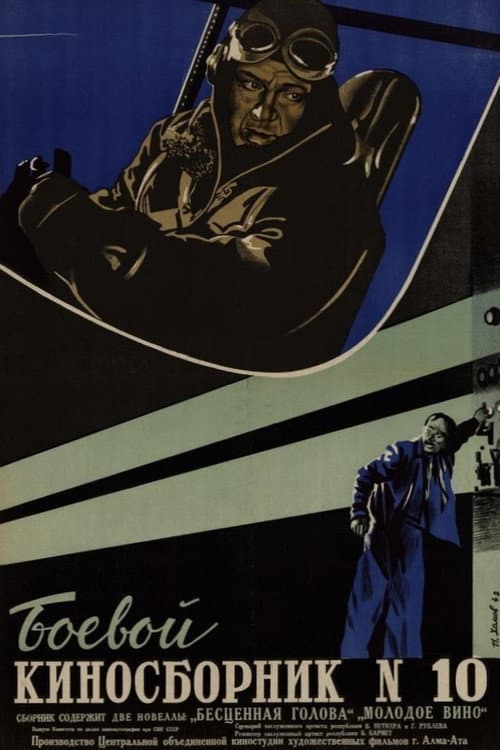
Fighting Film Collection No. 10 (Boyevoy kinosbornik No. 10) is the tenth issue of Boyevoy kinosbornik series, released in June 1942. It contains two segments: "Bestsennaya golova/A Priceless Head" and "Molodoye vino/Young Wine". Both depict the anti-Nazi resistance, the first in Poland and the second in Romania.
Jun 1942
Aug 1942
This is the second part of a projected three-part epic biopic of Russian Czar Ivan Grozny, undertaken by Soviet film-maker Sergei Eisenstein at the behest of Josef Stalin. Production of the epic was stopped before the third part could be filmed, due to producer dissatisfaction with Eisenstein's introducing forbidden experimental filming techniques into the material, more evident in this part than the first part. As it was, this second part was banned from showings until after the deaths of both Eisenstein and Stalin, and a change of attitude by the subsequent heads of the Soviet government. In this part, as Ivan the Terrible attempts to consolidate his power by establishing a personal army, his political rivals, the Russian boyars, plot to assassinate him.
Oct 1958
After several days of the offensive, the Red Army detachment settles down to rest. At a halt, the warrior Kuregen tells his comrades-in-arms the story of the feat of the legendary Kazakh batyr Tolagai, who sacrificed his life for the people's good a thousand years ago.
Jan 1942
Aug 1943
In the summer of 1932, Sergei Lukonin, a young man from Saratov, leaves his hometown for the distant city of Omsk to attend tank school. His fiancée, Varenka, who soon became an actress, remained in Saratov. In 1936, Sergei went to fight in the Spanish Civil War. He was wounded, taken prisoner, escaped, and returned to training battles, with June 1941 looming ahead.
The autumn of 1941. Leningrad is besieged by the Nazis. A new model of tank is being developed at a large defense plant. Built in the shortest possible time combat vehicles are tested directly on battlefields, fighting with fascists in the outskirts of the city. The first feature film about the heroic everyday life of city defenders was shot directly in assembly shops of plants and in the streets of Leningrad when the city was fighting against the enemy
Jan 1943
One of the anthology films about Soviet citizens resisting the Nazi invaders during World War II, the feature consists of two stories, one about a teenage woman telephone operator who sacrifices herself, the other about a farm girl tending a sick pig who deals with two paratroopers seeking shelter.
Apr 1942
The true story of one of Russia's most beloved national heroines. During the Nazi siege of Moscow, a fearless 18-year-old girl named Zoya risked her life as a partisan fighter. Captured by the Germans, Zoya endured unspeakable tortures at the hands of the Gestapo but still refused to betray her comrades. Even on the gallows, Zoya defiantly spoke out against the Nazis and everything they stood for. In a series of flashbacks, this film re-creates not merely Zoya's death, but also her life.
The film deals with a Russian battalion under siege by the Germans during the Second World War.
Jul 1943
A group of Russian partisans hiding within a remote forest attempt to destroy a nearby German airfield, all the while assisting a downed French pilot who happens to fall madly in love with a local girl.
The first day of the war brings tragedy to a peasant woman, Pasha. Her husband and her toddler son die before her eyes. She and the other villagers leave to go into the woods. Pasha leads the villagers to fight some German troops. Coming out victories, the partisans become a feared opponent of the Germans, with the leadership of Comrade P.
May 1943
A musical romantic comedy set in Soviet Union during the first years of WWII.
A story about a Secretary of the Communist Party District Committee who is leading partisans in their fight with the Nazis during WWII.
Nov 1942
A story of true love set during the WWII.
Nov 1943
Film-opera based on Tschaikovsky's adaptation of Gogol's story, 'Noch' pyered Rozhdestvom.'
Apr 1945
Directed by Sergey Vasilev and Georgi Vasilyev.
Dec 1943
Brecht's play Fear and Misery of the Third Reich consists of a series of playlets, portraying National Socialist Germany of the 1930s as a land of poverty, violence, fear and pretence. Nazi antisemitism is depicted in several of the sketches, including "the Physicist", "Judicial Process", and "the Jewish Wife".